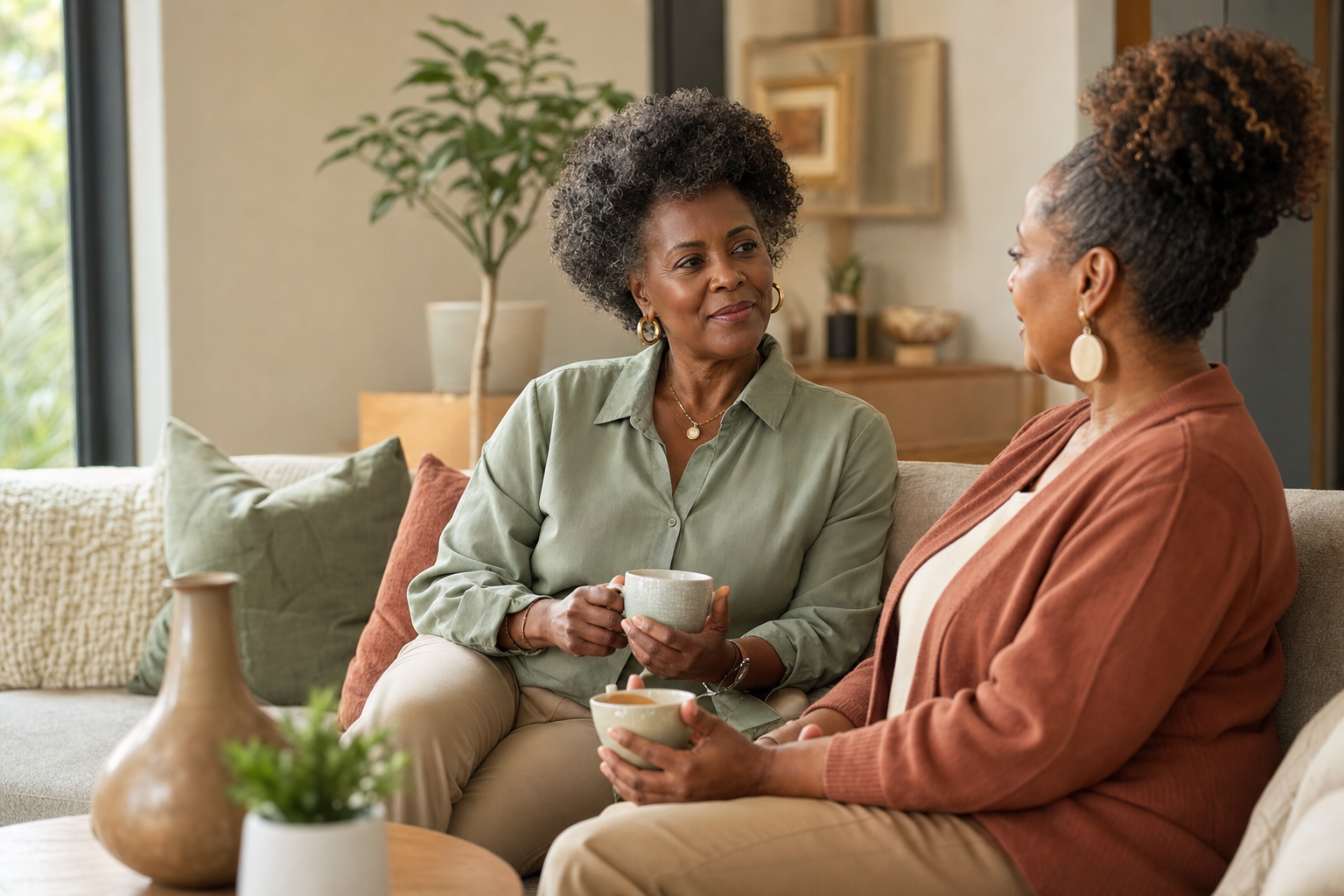
Black women and menopause: why the conversation matters
Black women and menopause is not only a biological transition. It is also shaped by how openly the topic is discussed, understood, and supported in families, communities, and healthcare settings. The World Health Organization notes that menopause is influenced by social and cultural factors, and that access to information and support can improve wellbeing during this stage [2].
In many communities, menopause is still treated as private or even awkward to mention. Opening the conversation matters because it can help more women recognize changes earlier, understand what they are experiencing, and feel less alone.
What it means to talk about menopause in Black women
Talking about menopause in Black women means recognizing that this transition has often been less visible in public spaces and even in health conversations. Not every woman experiences it the same way, and not everyone gets the same information or support. That difference matters.
Scientific evidence also shows that reproductive aging and some midlife health outcomes can differ between Black women and White women [3]. That does not mean every experience is the same. It does mean that more visibility, more education, and more culturally relevant support are needed.
Common symptoms and changes during the transition
Perimenopause and menopause can include a wide range of physical and emotional changes. MedlinePlus describes common symptoms such as irregular periods, hot flashes, sleep changes, vaginal dryness, and mood shifts [1].
Just as important, the experience can vary widely from one woman to another. Some notice mild changes; others feel more intense symptoms or longer-lasting shifts. It is also common to wonder what is normal and when to seek guidance.
Common changes may include:
- irregular menstrual cycles
- hot flashes or sweating
- less restful sleep
- irritability or mood changes
- physical discomfort that feels new
Naming these symptoms clearly can make menopause feel less vague and less isolating.
Why menopause education improves wellbeing
Education about menopause is not about fear or overreacting to every symptom. It is about giving context. When a woman understands what may be happening in her body, she is better prepared to make informed decisions and ask for help when needed.
The WHO says access to reliable information is part of healthy aging [2]. In practical terms, menopause education can help women:
- recognize symptoms without confusion
- tell the difference between expected changes and issues that need attention
- reduce shame or worry
- communicate more clearly with healthcare professionals
Clear information also supports wellbeing in menopause, because understanding often reduces isolation and uncertainty.
The role of menopause conversations in the community
Menopause conversations should not happen only in private appointments. Community spaces, open talks, and trusted peer networks can make a real difference in breaking stigma.
A qualitative study of Black women found that cultural silence and communication barriers can make it harder to talk freely about women’s health topics [4]. That helps explain why trusted group conversations can be so powerful.
When one woman hears another say, “I’ve been through that too,” the topic becomes less lonely. That kind of validation can help turn menopause without taboos into something more open and human.
Black women’s health and access to trusted information
Black women’s health needs information that is clear, culturally relevant, and easy to trust. It is not enough for information to exist; it also has to reflect the social and emotional reality of the people seeking it.
That is why leadership in women’s health, support groups, and community-based education matter. These efforts can bring the conversation into schools, churches, community centers, and workplaces.
The goal is not to replace medical care. It is to give women better context for the menopause transition and more confidence in understanding common menopause symptoms before they talk with a healthcare professional.
How to encourage menopause without taboos
Normalizing this topic does not require a large campaign to begin. Often, it starts with small changes in how people speak at home and in the community.
A few realistic ways to make the conversation more open:
- mention menopause without jokes or euphemisms
- listen without minimizing symptoms
- share reliable information in trusted spaces
- include menopause in women’s health and wellbeing discussions
- encourage support if the transition affects daily life
It also helps to remember that the experience may differ among Black and African American women, so support should be respectful and should not assume one single story.
When to talk with a healthcare professional
Even though menopause is a natural life stage, it is still worth speaking with a healthcare professional if symptoms are hard to manage or if questions keep coming up. Asking for guidance is not overreacting; it is part of taking care of yourself.
It can be helpful to talk to a professional if sleep, mood, or daily routine are being affected, or if you are unsure what is normal in this transition. Education and open conversation work best when they are paired with accessible clinical support.
Closing thoughts
Talking about Black women and menopause means talking about health, information, and community. When silence is broken, it becomes easier to understand the body, ask for support without shame, and move through this stage with more confidence.
Opening the conversation is a simple first step, but it can make menopause feel more visible, more understood, and less alone.
Sources consulted
- [1] MedlinePlus, "Menopausia" — https://medlineplus.gov/spanish/menopause.html
- [2] World Health Organization, "Menopause" — https://www.who.int/news-room/fact-sheets/detail/menopause
- [3] PubMed Central, "Disparities in Reproductive Aging and Midlife Health between Black and White women: The Study of Women’s Health Across the Nation (SWAN)" — https://pmc.ncbi.nlm.nih.gov/articles/PMC8822825/
- [4] PubMed Central, "Muddling through the Health System: Experiences of Three Groups of Black Women in Three Regions" — https://pmc.ncbi.nlm.nih.gov/articles/PMC5909110/