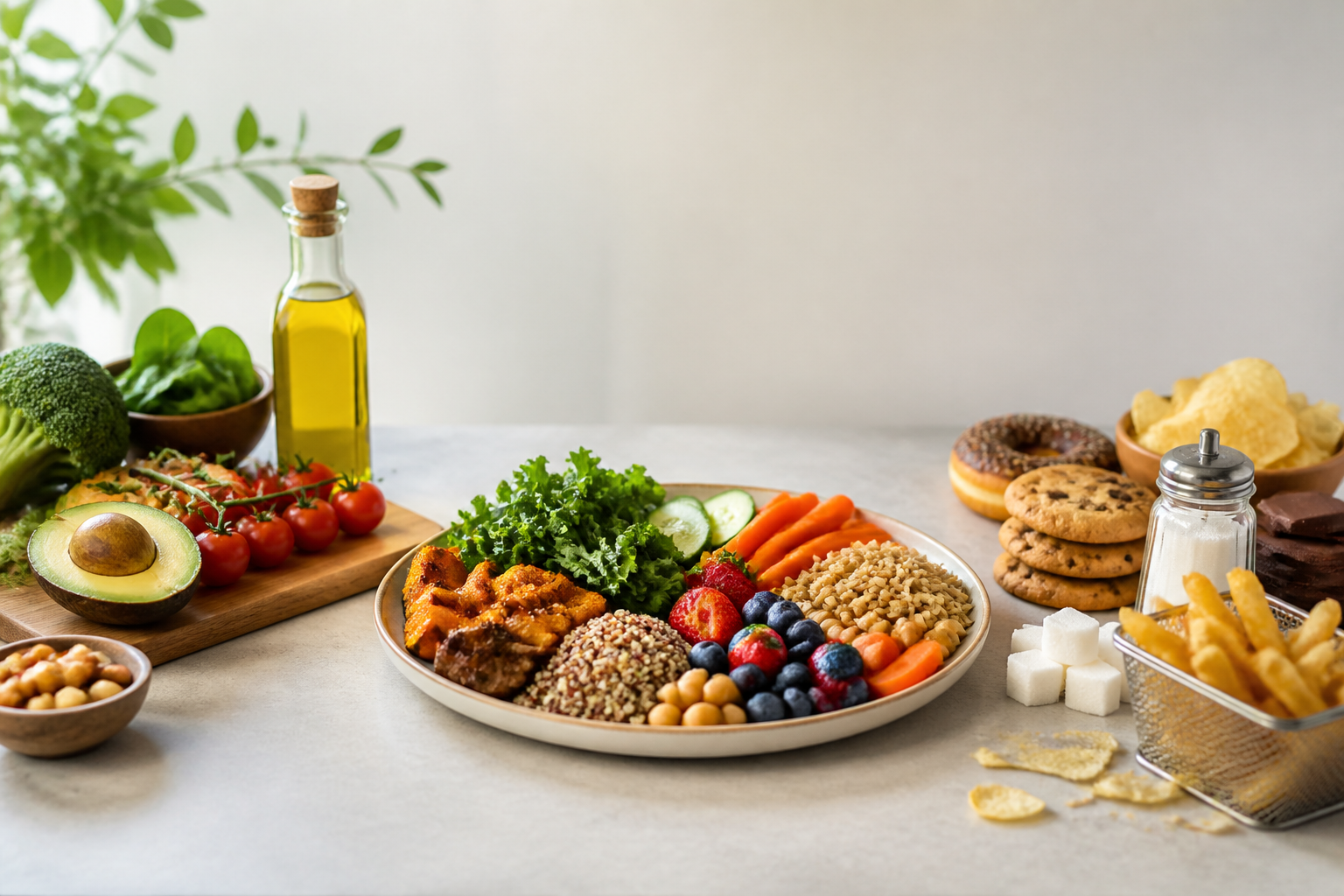
What is the link between food and aging?
The link between food and healthy aging is not about one single meal. What matters most is the overall eating pattern over time. The National Institute on Aging notes that choices like eating more fruits, vegetables, whole grains, healthy fats, and lean proteins can support healthier aging [1].
That does not mean one less-than-ideal day suddenly changes everything. It means repeated habits can add up over the years, affecting energy, heart health, and overall well-being. The big picture matters: what you eat, how often you eat it, and the balance of the full diet.
Signs a diet may not be supporting healthy aging
There is no single sign that proves a diet is the cause of a problem, but some clues can suggest that eating habits may be off balance. People may notice frequent fatigue, lower energy, slower recovery, or visible changes in the skin. Some also feel overly heavy after meals or rely heavily on ultraprocessed foods.
These signs are not a diagnosis. They are simply a prompt to look at whether the current pattern provides enough variety, fiber, and nutritional quality.
Foods and patterns worth limiting
When people talk about “foods that age you,” they often mean patterns that are too high in sodium, added sugar, trans fat, or low-quality calories. The WHO recommends limiting free sugars, excess unhealthy fats, and low-nutrient foods within a balanced diet [3].
Common examples include:
- Ultraprocessed foods that are high in sodium, sugar, or unhealthy fats.
- Drinks and foods with frequent added sugar.
- Highly refined foods that are low in fiber.
- Foods containing trans fats or made with lower-quality nutrition in mind.
- Repetitive meals with very few fruits, vegetables, or legumes.
The issue is usually not one isolated food. It is the frequency and the place it holds in the daily pattern.
How sugar, salt, and trans fat may affect aging
Too much sugar, sodium, and trans fat can affect health in several ways. The WHO states that high sodium intake is linked with elevated blood pressure and higher cardiovascular risk [4]. It also highlights trans fat for its negative impact on heart health [5].
In general terms, that matters for aging because cardiovascular health, inflammation, and diet quality are closely connected to how we feel and function as we get older. A pattern high in added sugar and ultraprocessed foods can also crowd out more nutrient-dense choices, leaving less room for fiber, quality protein, and key nutrients.
This is not about demonizing one ingredient. It is about frequency. When these foods show up every day, the overall pattern becomes less supportive of healthy aging.
Inflammatory foods and overall health
When people use the term inflammatory foods, they often mean diets that are high in ultraprocessed items, trans fat, added sugar, and sodium, while being low in fresh foods. The useful takeaway is simple: the body usually responds better when the diet is varied, moderate, and built around higher-quality foods.
The relationship between diet, inflammation, and aging does not depend on one single component. It depends on the full eating pattern. That is why balance is more helpful than extreme rules.
What to eat to age better
The most consistent recommendation is to return to a base of simple, varied foods. Both the WHO and the National Institute on Aging highlight patterns that include fruits, vegetables, legumes, whole grains, healthy fats, and quality proteins [1][3].
A practical way to build meals is:
- Fill much of the plate with vegetables and fruits.
- Choose whole grains more often.
- Include legumes several times per week.
- Prioritize quality protein within a balanced pattern.
- Drink water regularly throughout the day.
- Leave room for healthy fats in reasonable portions.
These changes are not about perfection. They are about consistency. A diet for healthy aging works best when it is realistic and sustainable.
Eating habits that support healthy aging
Food choices are only part of the picture. Eating at fairly regular times, keeping portions appropriate, and reducing the frequent use of ultraprocessed foods can make the overall pattern more stable and varied.
It also helps to look at the bigger lifestyle context: good sleep, regular movement, and steady routines often go hand in hand with better nutrition. Even though this article focuses on food, healthy aging is shaped by several connected factors.
Practical tips for making changes
Big changes are not necessary. Small steps are often easier to keep:
- Read labels to spot excess sodium, added sugars, or trans fat.
- Replace some ultraprocessed foods with simpler, fresher options.
- Add one extra fruit or vegetable each day.
- Include legumes in meals during the week.
- Choose whole grains when possible.
- Stay consistently hydrated.
If you are unsure how to adapt your eating pattern to your age, activity level, or a health condition, it can be helpful to talk with a health or nutrition professional.
The bottom line
The foods that may speed aging are not a fixed list. They are part of a broader pattern: too much sugar, salt, trans fat, and ultraprocessed food, combined with low variety and poor nutritional quality. The good news is that there is also a better pattern: more fruits, vegetables, legumes, whole grains, quality protein, healthy fats, and hydration [1][3].
Thinking in terms of frequency, balance, and consistency makes it easier to make better choices without going to extremes.
Sources consulted
- What Do We Know About Healthy Aging? — National Institute on Aging (NIH) — https://www.nia.nih.gov/health/healthy-aging/what-do-we-know-about-healthy-aging
- Midlife eating patterns tied to health decades later — National Institutes of Health (NIH) — https://www.nih.gov/news-events/nih-research-matters/midlife-eating-patterns-tied-health-decades-later
- Healthy diet — World Health Organization (WHO) — https://www.who.int/news-room/fact-sheets/detail/healthy-diet
- Sodium reduction — World Health Organization (WHO) — https://www.who.int/news-room/fact-sheets/detail/sodium-reduction
- Trans fat — World Health Organization (WHO) — https://www.who.int/news-room/fact-sheets/detail/trans-fat/